Thursday, December 10, 2020

  Voyager America  

Folk Art: Numero Dos....very cool stuff


Is one good idea enough?Is this enough? 
Is variation really pleasurable? Are dreams a limitation? Is anger useful?
Does thinking about happiness prevent it? Is repetition ok? Does novelty matter?
Is growth desirable? Is calm an illusion? Does fear drive us? Is there always more? Is choice 
possible? Are feelings independent of place? Does getting drunk help? Is experience
repeatable? Do thoughts follow actions? Is change necessary? Are expectations a problem?
Can purity be created? Are we born innocent? Is this progress? Is austerity an illusion?
Can complexity be simple?
(Marfa, TX)


Socorro City Hall mural depicts local highlights...Sandhill Cranes at the Bosque del Apache,
one of the oldest mission churches in NM, dark skies, colorful cacti, and the
passing on of cowboy roping skills.


Lady of Socorro


Datil, NM 


Mine Shaft Tavern in Golden, NM, one of the current
great roadhouses in America.


Cowhand and steer metal art, Magdalena


Mural at Tesuque Village Market, Tesuque Village, NM


Sculpture honoring the men of the oil industry in Artesia, NM


Giant Roadrunner welcomes you to Fort Stockton, TX


Carrizozo, NM


This is Nina's house in Magdalena. The figures adorning the top of her wall all relate to Magdalena.
From left to right - Wolf Debate; Hummingbirds in summer; Old Timers' Rodeo (July); Enchanted
Skies Star Party (Oct); Festival of Cranes (Nov); Wildlife (Ringtale); Noisy Peacock Neighbor.


Tony's Rock (and Junk) Shop, Magdalena, NM


Angel at a Taos coffee shop


Go with the Gods!


Tuesday, December 1, 2020

 Voyager America  

A Glorious Fall in the Bosque del Apache, NM


The guiding idea that led to our journey to New Mexico this November was to witness the return of the Sandhill Cranes to winter in the Bosque del Apache National Wildlife Refuge.  Each year, starting in November, thousands of Sandhill Cranes return to the Bosque region. Some years ago we saw photos of the Cranes migrating on the North Platte River in Nebraska, and we have dreamed about coming to the Bosque to see these Cranes ever since.  The Rio Grande River cuts right through the Bosque and is the life-giving force that creates this vibrant environment that the Cranes return to each winter. 


70 million years ago the parting of two massive tectonic plates created the Rio Grande rift valley.  The valley runs from north of Albuquerque, NM, to at least Las Cruces, NM, in the south.  Once the valley was formed, the Rio Grande river has shaped the valley ever since.  It is now a river that has been tamed by irrigation and water management all along its way. However, this jewel of a river, which flows from the mountains in Colorado to Brownsville, TX, emptying into the Gulf, undergirds the history and productivity of its entire length.  Karen and I stood by the Rio Grande, called the Rio Bravo del Norte in Mexico, in Big Bend, TX, and now we have roamed the river again in the Rio Grande rift. 


Wildlife refuges and private farmers throughout the Rio Grande
Valley plant food, such as corn, and flood fields with water for
the migrating birds.


Snow Geese and Ross's Geese


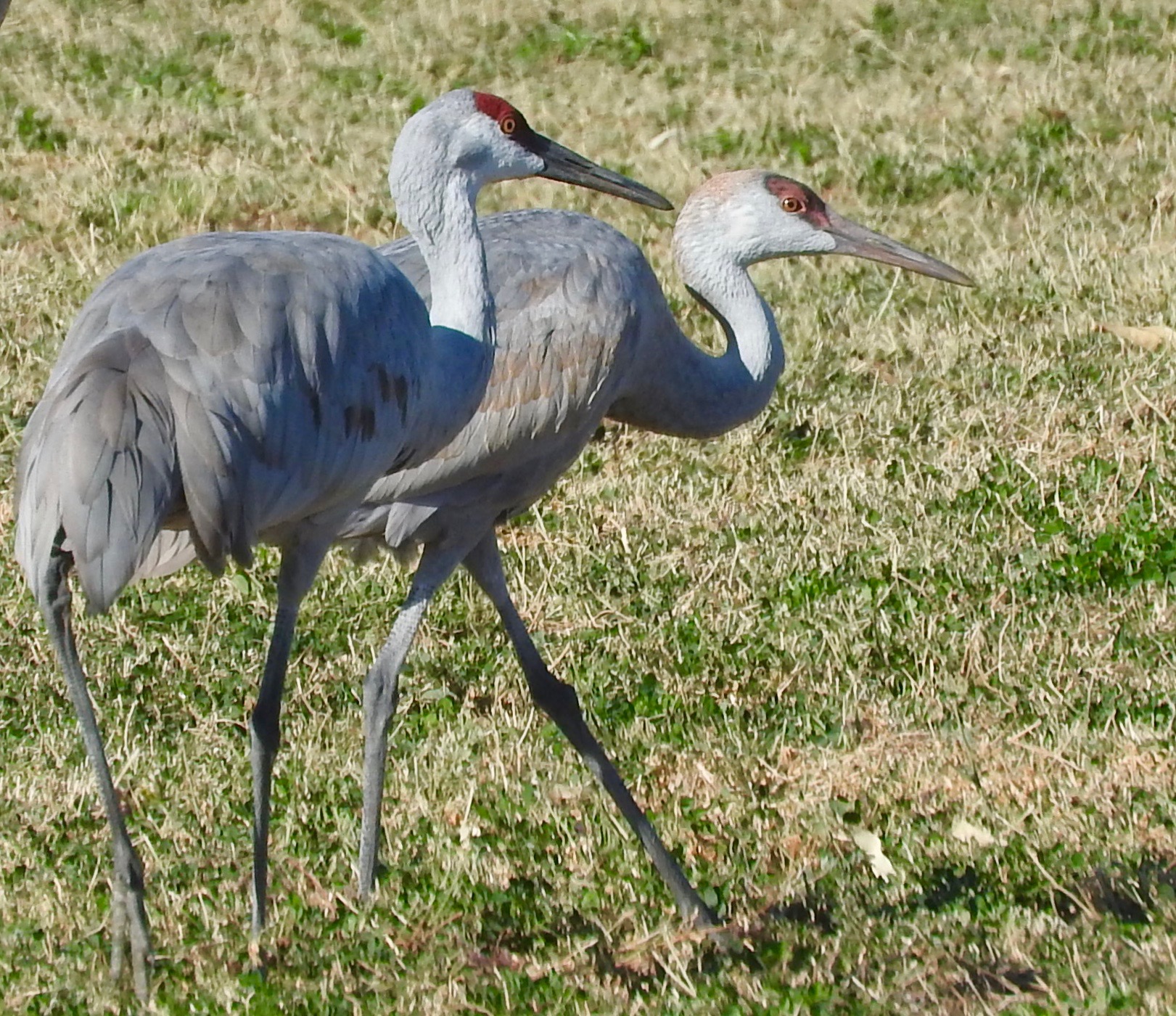
Sandhill Cranes


The Sandhill Cranes that converge on the Rio Grande Valley in the fall migrate
from Siberia, Alaska, Canada and the northern Rocky Mountains.


The combination of being in a rift valley and seeing the fall colors of the grasslands and trees that filled the landscape, led us both to recall the Great Rift Valley in Africa and specifically the grassland and acacia tree landscapes of Uganda, Tanzania, and South Africa.  We also were amazed to learn that not only do Sandhill Cranes come here to winter, but so do Snow Geese, including Ross's Geese, and Blackbirds, including Redwing and Brewer's, in large numbers. The interplay of the three types of birds reminded us right away of the wildebeest, zebra, and Thomson's Gazelle migration in the Serengeti in Tanzania. And just like in Africa, such large numbers of birds bring out an array of predators including eagles, hawks, falcons, coyotes, which we saw everyday, and bobcats, that stayed hidden from us. The Bosque del Apache is bursting with life at every turn.  


Arizona Barrel Cactus


Thousands of Blackbirds take flight.


A Northern Harrier caused these birds to fly up all together.
The Northern Harrier is the bigger black bird in the middle.


This photo unfortunately is not in focus, but it shows an Albino Blackbird which we have never seen before and is really unusual. Fellow birders told us that there was an albino in the flock of birds we
were watching. It took quite a while to locate the white bird among thousands of black birds.


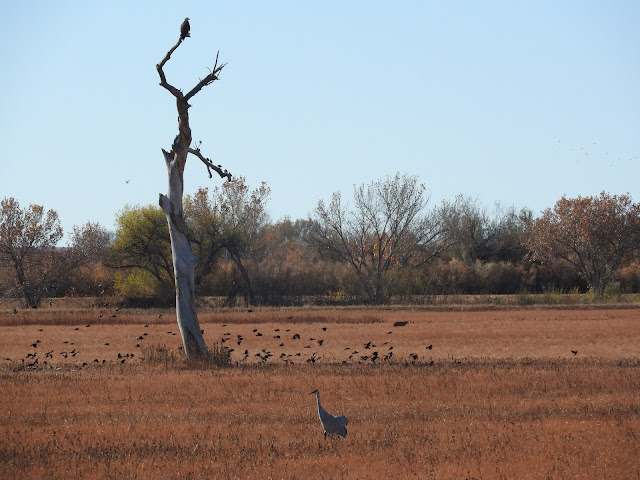
A Bald Eagle sits atop this dead tree while Blackbirds sit on a lower branch and fly around below.
A Sandhill Crane walks in front, while a Coyote walks behind. What a tapestry of life!


House Finch on Cane Cholla Cactus at sunset.


Because the Rio Grande cuts through the entire rift valley here, there is bird and wildlife activity throughout the entire valley.  It has not been uncommon for us to see Sandhill Cranes, Snow Geese, black birds, and a wide variety of other birds and animals in fields and open areas all along the valley. It is a large, magical ecosystem with the Bosque at its heart. 


Sunset at the Bosque with Sandhill Cranes


Sunday, November 29, 2020

 Voyager America  

In the Time of COVID....

For the most part, our travels during this pandemic have been safe and we luckily have remained symptom free.  We have been able to travel from state to state with no restriction and nearly everyone we've come in contact with has been welcoming, courteous, and wearing a mask. We've followed the few simple rules: wear a mask, keep a safe distance from others, especially indoors, and we wash our hands frequently.  Somewhere in Texas, we decided to only get our food in markets or as take out, no longer eating in restaurants.  Much like we did in Philadelphia, we spend our time just together and doing outdoor things like hiking, birding, and bike riding, or touring around in our car. We are able to do almost everything we would like to do and feel safe doing it. 


The San Miguel Mission Church, Santa Fe. 
It is referred to as the oldest church in the
United States and was originally built around 1610.


This sign hangs on the doors to the San Miguel Mission seen behind us in the photo above.
The State of New Mexico started a 2-week lockdown and stay at home order on
November 16 to hopefully reverse the alarming escalation of COVID cases in the state.


Highway signs like these are seen all over the state.


New Mexico began an all-state lockdown almost two weeks ago.  They plan to loosen restrictions a bit this coming week, but will still be under state-wide restrictions until the number of cases begins to dissipate. There is a state order here to wear masks and most people are complying with this.  Like everywhere in the world, those people who are the poorest are suffering the most in New Mexico.  

Native nations make up about 10% of New Mexico's population, but account for 23% of the state's COVID cases and, more devastatingly, over 40% of the deaths due to COVID.  The communal nature of the Native people, a clear strength, is now one of the main causes for the spread of the disease.  All of the Pueblos and reservations have been closed to others, and coming and going for those living in them is monitored closely. The Navajo Nation, the largest native group in New Mexico, has a small portion of their reservation in Alamo, just down the road from where we are staying in Magdalena. Along with the great loss and suffering caused by COVID, the disruption to traditional ways and sacred practices has created a deep wound.


All pueblos and reservations in New Mexico are closed to outsiders because of the alarmingly
high number of COVID cases. Pueblo residents who must leave their homes for work are being
carefully monitored. 


The Days Inn in Socorro will continue to house COVID-19
patients who are in quarantine from the nearby Alamo Navajo
Indian Reservation.


The Visitor Centers at all national parks and monuments are closed.
Many of them, such as Bandelier National Monument near Santa Fe, have tables set up outdoors
with lots of park information and a park ranger there to answer any questions.


Signs plastered over the entrance to a Sprouts market in Santa Fe state "FACE MASKS REQUIRED
FOR ENTRY" and "FEELING SICK? PLEASE DO NOT COME INTO OUR STORE WHEN YOU
ARE FEELING SICK!" They also post a list of behaviors to follow such as only touch the products
you'd like to purchase and don't sample any products in the store.


We have seen how hard so many regular folks are working to get through the pandemic and also to help so many others get through, too.  We both feel so grateful for such efforts and understand that a trip like we are taking could only be safe because of the efforts of so many people.  Each day we try to remain vigilant and almost all of our actions and plans are made to stay out of harms way. We are also saddened and dismayed at the continued strength of this disease and at how easy it seems to be to let one's guard down, which then can aid significantly in spreading it. Like many of us, we are encouraged by the vaccine progress.  We also hope we can continue to come together as a nation to follow those simple rules that can cut down significantly on COVID's spread-----and that we see clearly who is in most need----and help life become more safe for them.